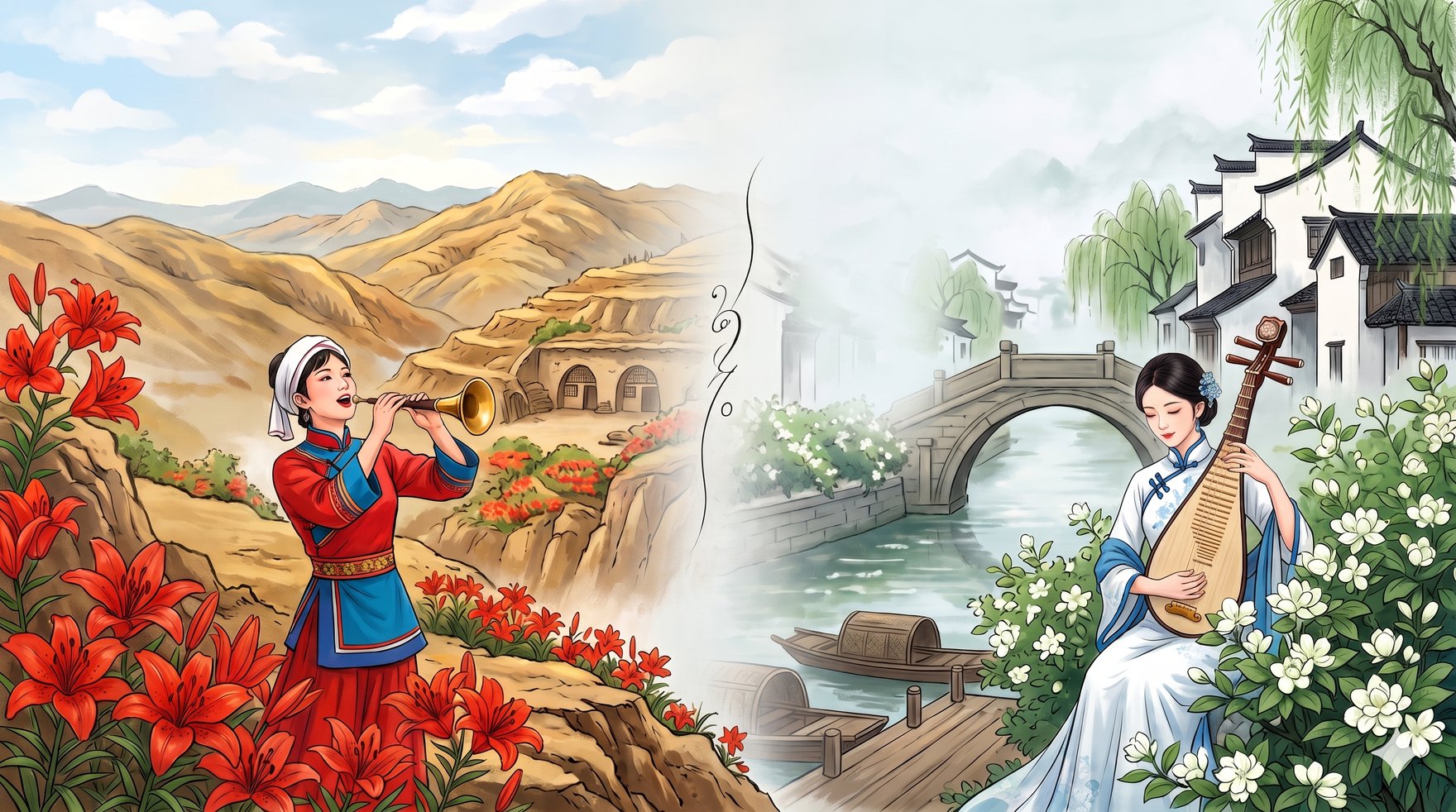
Most folk songs of the Han Chinese ethnic group (汉族) are built on the same pentatonic scale (宫商角徵羽), yet tunes from the north and the south can sound worlds apart. Up on the wind-blown Loess Plateau (黄土高坡) of the Yellow River (黄河) valley, the xintianyou (信天游) ballads of Northern Shaanxi (陕北) ring out high and mournful, steeped in a vast, aching desolation; down in the water towns of Jiangnan (江南) — the land south of the lower reaches of the Yangtze River (长江) — the soft Wu dialect (吴侬软语) turns melody tender and lingering, delicate and refined. This project compares the two textures by quantifying the melody itself: it measures the semitone (chromatic) distance between every consecutive pair of notes in a theme, then shows it two ways — a melodic contour with each leap labeled and color-coded, and an interval-distribution histogram — so a region's musical "accent" becomes something you can see.
The Jiangnan (江南) signature is the mirror image: mostly 3rds and small steps, so the line stays smooth and close — gentle and delicate — with few or no orange boxes. Jiangnan's 3-mers settle instead into soft tertian shapes — C·G·A (Am7-type), D·E·G (Em7-type) — and the stepwise G⇄A. The triangle wheels below show it at a glance.
Shandong (山东) sits between the two — a third-texture extension (example: 《沂蒙山小调》): wide leaps do appear, but singly, set into largely stepwise motion, rather than chaining into the Shaanxi saw-tooth. Each interval is also named (e.g. Perfect 5th / P5), tying the picture back to the hypothesis.
Triangle signatures — every 3-mer as a chord · 4 陕北 vs 4 江南
Every three consecutive notes drawn as a triangle on the 12-tone clock (tonic C at 12 o'clock, all tunes normalized to 1 = C). Orange = triangles containing a 4th/5th leap, bold outline = oscillating leaps; blue/green = 3rds and steps. N. Shaanxi fills the circle with suspended crossings; Jiangnan wreathes the rim.
Trace the melodies on the 12-tone clock
Press ▶ Play & trace — each interval draws itself on the wheel as its note sounds (tonic C at 12 o'clock, 1 = C for both tunes). N. Shaanxi's 4ths and 5ths slice across the circle; Jiangnan's steps and 3rds stay on the rim.
Chinese folk songs, and melodies inspired by or adapted from them.
→ Full 4-vs-4 statistical comparison — pooled interval distributions, significance tests (chi-square + Mann–Whitney), and summary plots across the eight core tunes.